Microsoft Copilot in the Workplace in Noord Holland
Introduction
Some developments first feel a bit far away. Interesting, sure. But not something you need to act on today.
For many companies, that was true of AI for a long time. You heard about it on podcasts, saw it on LinkedIn and read more and more about the future of work. It sounded promising, but also rather abstract.
Until suddenly it gets very close. For example in moments like these:
- Your inbox is fuller than you'd like
- A meeting produces good ideas, but no one has time to work them out properly
- Someone is once again spending too long searching for the essentials in an Excel file
- A team isn't busy because of one big problem, but because of many small tasks at once
And that's exactly when the question changes. No longer: should we do something with AI? But rather: can this help us today?
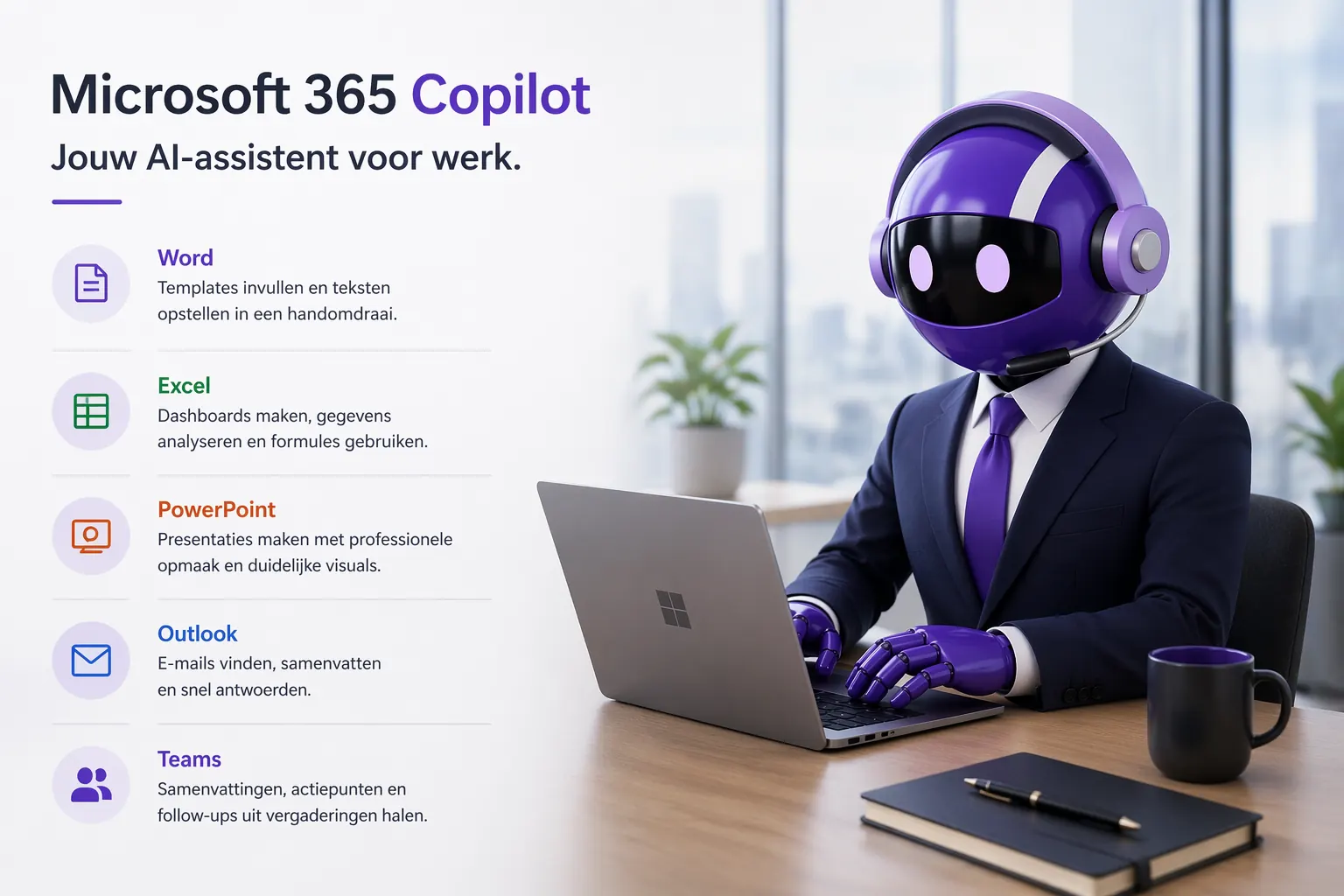
That is also exactly the moment when AI becomes interesting. Not as a futuristic story, but as practical help in the working day. And that is precisely where Microsoft Copilot Chat and Premium fit well for many organizations, because it doesn't sit beside the work but is woven into it. In tools like Outlook, Word, Excel, Teams and PowerPoint [1][2].
Why this feels so logical in Noord Holland
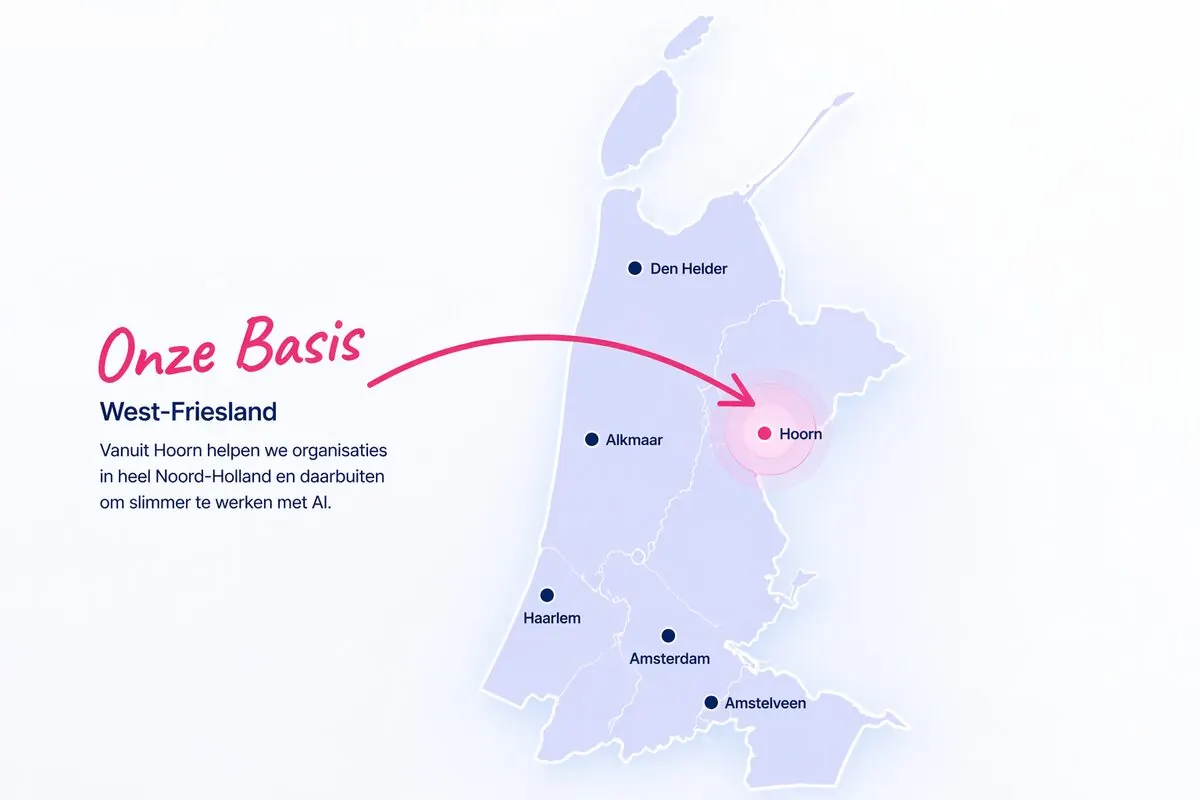
What makes AI interesting in Noord Holland is not only the technology itself. It also has to do with how many companies in this region look at innovation. In cities such as Amsterdam, Haarlem, Zaanstad, Alkmaar, Hoorn and Den Helder you see that this movement takes a slightly different shape everywhere, but with the same foundation.
The mentality is often down-to-earth and practical:
- Does it really work?
- Does it save time?
- Does it fit how people already work?
That makes the step toward AI different from environments where innovation mainly remains a big story on paper. In Noord Holland, many organizations primarily want to know what helps today. Whether that's a scale-up in Amsterdam, a service provider in Haarlem or an SME team in West Friesland.
And that feeling is also supported by data. The CBS AI Monitor shows that Noord Holland is the province with the largest share of AI-producing companies in the Netherlands [3]. In the underlying dataset, that means 130 of the 402 identified AI companies, roughly 32 percent of the total [3].
Maybe that's exactly why Copilot resonates
Many digital innovations initially feel like extra work.
- Yet another system
- Yet another tool to learn
- Yet another process to redesign
That makes change feel heavy, before it even delivers anything.
Copilot feels different to many organizations, because it connects to the tools people already use every day. That makes it feel less like a separate innovation project and more like a smart layer over existing work [1][2].
Microsoft describes Microsoft Copilot as an AI assistant for work within the Microsoft 365 environment, in which existing permissions, security and governance are respected. Sometimes there is some setup work, but in practice this is often manageable [1][2].
And precisely that makes it not only practical for many organizations, but also more familiar.
What we at AmeCoda from West Friesland often see ourselves
For us this topic is not only interesting because of high demand. It also feels close. We come from West Friesland ourselves. That's why we recognize the way many organizations here think.
- Not too much fuss
- Not too many big words
- Just something that works
We understand you don't want a complicated system. You want something that works, is effective and easy to understand. For example Copilot for quotes, reporting, preparation, recurring communication and finding information faster.
A few examples that are immediately recognizable
AI is sometimes explained so grandly that it actually starts to feel vague. While the first value is often surprisingly simple.
After a Teams meeting
A lot was discussed. The ideas were good. But no one feels like writing up all the notes. Copilot can then help with:
- A summary
- Action items
- An overview of next steps
With a messy Excel file
Multiple colleagues have worked on it and you want to quickly understand what you're seeing. Then Copilot helps to:
- Bring structure
- Identify key points faster
- Move toward analysis more quickly
For quotes, proposals or internal updates
You don't want to start from scratch every time. Copilot can help with a first draft, so you move from idea to usable version faster.
In an overflowing mailbox
You have little time and many messages. Then Copilot can help with:
- Summarizing
- Rewriting
- Replying faster
- Separating main issues from side issues
- Finding emails back
- Prioritizing emails
That may sound small. But that is often where the real power lies. Adoption rarely starts with something spectacular. It usually starts with something that feels immediately useful.
Smaller and mid-sized companies can benefit a lot here
AI is still often associated with large corporates with big budgets and full innovation teams. But in practice, SMEs can benefit greatly.
Why? Because every minute saved is immediately noticeable there.
At the same time, CBS shows that smaller companies are still lagging behind larger companies in AI use [4]. That doesn't mean AI is less relevant for them. Rather the opposite. It shows there is still a lot of room.
For a smaller team, time savings can immediately make a difference:
- Less repetitive work
- Faster from meeting to action
- Less time spent on first drafts
- More attention for work that really counts
In closing
Anyone searching for AI Noord Holland, Copilot Noord Holland, AI Hoorn, AI Alkmaar, AI Amsterdam or AI West Friesland is usually not looking for a technical story full of difficult terms. They are mostly looking for recognition. For questions like:
- Does this fit us too?
- Can this work in our organization?
- Without extra hassle?
- Without it immediately becoming a huge project?
Our honest answer is: yes, very often. Especially in Noord Holland. Especially in organizations where people want to move forward, but stay practical.
And perhaps precisely because we at AmeCoda come from West Friesland ourselves, we recognize that way of thinking well. That's why translating AI to daily work doesn't feel forced to us, but logical.
Not because AI is a buzzword. But because, when you use it well, it can really help.
References
- [1]https://support.microsoft.com/nl-nl/microsoft-365-copilot
- [2]https://learn.microsoft.com/nl-nl/microsoft-365/copilot/microsoft-365-copilot-overview
- [3]https://www.cbs.nl/nl-nl/maatwerk/2025/09/ai-monitor-2024
- [4]https://www.cbs.nl/nl-nl/longread/rapportages/2026/gebruik-van-ai-technologie-door-nederlandse-microbedrijven