Why one AI ecosystem is smarter for growth
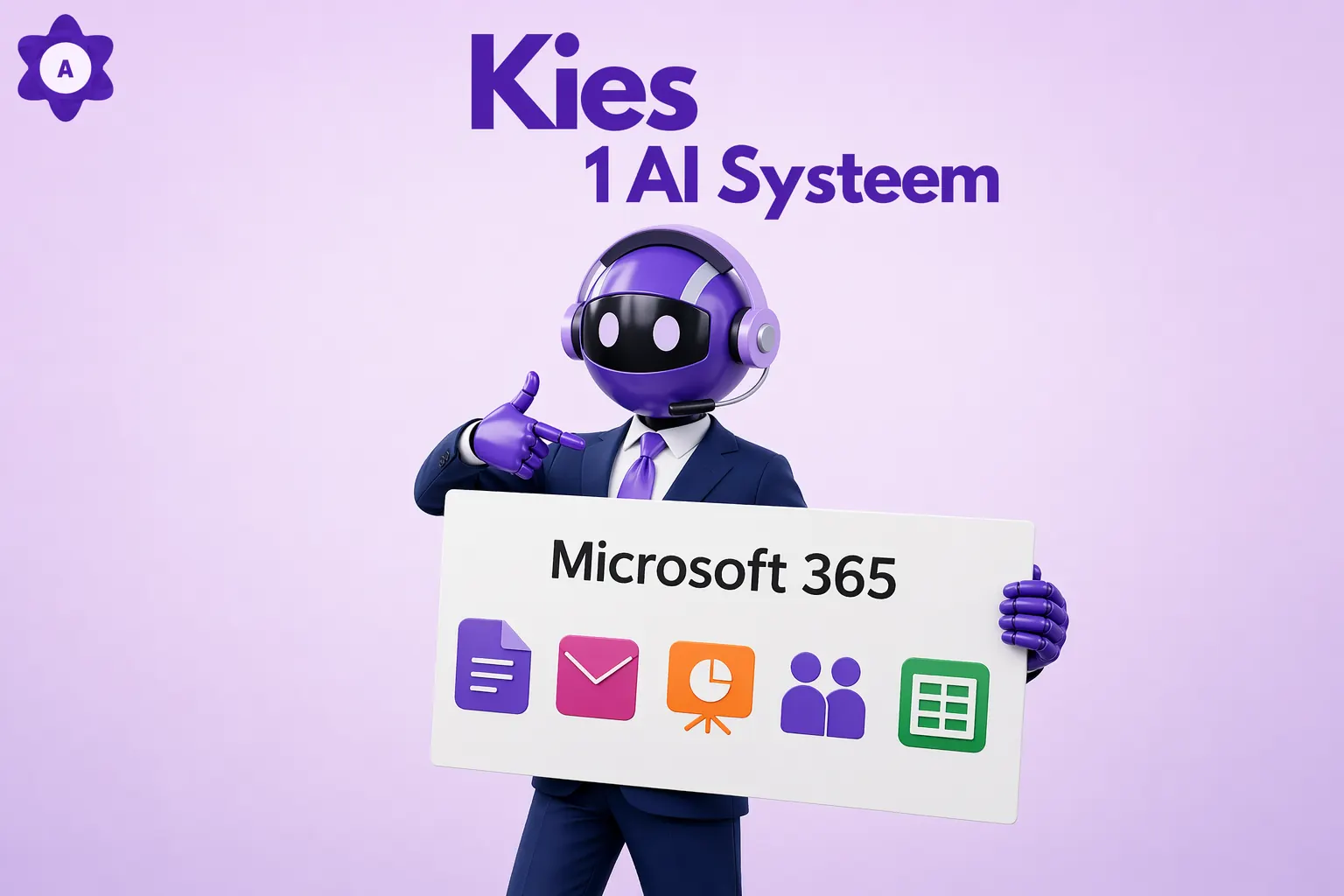
Many organizations start with separate AI tools. First a chatbot, then a content tool, then a workflow solution and later maybe agents. It seems fast, but without structure, fragmentation arises, you lose control and scaling becomes unnecessarily expensive.
That's exactly why it's smart to consciously choose one AI ecosystem as a foundation. This makes AI more manageable, safer and much easier to adopt across the entire organization [1].
The problem
The biggest mistake is not that companies start with AI. The biggest mistake is that they start without clear architecture. Teams then choose their own tool, prompts, integrations and workflow per department. This provides speed in the beginning, but almost always friction in execution.
Consequences become visible quickly in practice:
- Data is spread across different tools
- Governance becomes difficult
- Security and permissions are hard to manage centrally
- Users deal with multiple interfaces
- Management, support and training cost more time
- Scalability lags because everything becomes custom work
McKinsey research shows that organizations extract more value from AI when they redesign workflows and clearly assign governance [2]. At the same time, many companies struggle to bring AI from experiment to scalable application [3].
Without structure, failure isn't literally guaranteed, but the risk of delay, low adoption and limited value increases significantly. Especially when you want to grow from loose experiments to organization-wide deployment [1].
The solution
The smartest route is usually choosing one dominant AI ecosystem. Not because one vendor does everything perfectly, but because a central foundation provides calm in technology, processes and adoption. The starting point is simple: fewer ecosystems, greater chance of oversight, consistency and scale.
A good example is the Microsoft ecosystem. There you can grow step by step from simple support to advanced automation and agents. Think of Microsoft Copilot Chat for daily productivity, Microsoft Copilot Premium for deeper integration into your work processes and Copilot Agents for task-driven automation. Additionally, Power Automate plays an important role in connecting and automating workflows, while Copilot Studio provides the environment to build and manage your own agents and logic [4].
This creates one clear line: from personal assistant, to process automation, to intelligent agents. All within one coherent platform. Microsoft emphasizes the importance of clear instructions, triggers and control mechanisms when developing autonomous agents [5].
That's exactly what many organizations benefit from. You don't want a loose collection of tools, but a foundation you can grow on. First an internal assistant, then process automation, then task-driven agents and eventually more autonomous agents with clear guardrails.
At the same time, pragmatism remains important. Sometimes you need a specialized tool outside your core ecosystem, for example for video or niche applications. That's fine, as long as exceptions truly remain exceptions. The foundation must be central, controllable and scalable. That's why in practice: fewer ecosystems, better adoption [3].
How to apply this?
Choose a primary AI ecosystem
Determine which platform becomes the backbone of your AI strategy. Don't just look at standalone functionality, but especially at integration, security, governance and extensibility.
Ask yourself:
- Where are our users today?
- Which data and systems do we need to connect?
- Who will handle management and governance?
- How do we grow from assistants to workflows and agents?
Design a fixed growth path
Work with a maturity model instead of loose projects.
- Phase 1: personal productivity
- Phase 2: chatbots and knowledge assistants
- Phase 3: workflow automation
- Phase 4: agents for specific tasks
- Phase 5: autonomous agents with clear control
This structure prevents becoming too complex too early and helps teams trust and use AI step by step. Microsoft positions agent flows explicitly as building blocks for this growth [6].
Make governance part of the design from day one
Governance is not a brake on innovation. It's the prerequisite for scaling safely.
At minimum, establish:
- Which data may be used
- Who may build and publish agents
- How logging and monitoring are arranged
- Which processes need human control
- Which exceptions outside the ecosystem are allowed
McKinsey emphasizes that poor governance and unclear responsibility become increasingly costly as AI becomes more autonomous [1].
Limit exceptions consciously
Not every use case fits perfectly within one platform. It doesn't have to. But prevent exceptions from becoming the standard. Only use external tools when there's a clear business reason.
The rule of thumb is simple: centralize where you can, specialize only where you truly must.
Focus on adoption, not just technology
An ecosystem only works when people actually use it. Therefore, train on one way of working. Use the same language, the same guidelines and as much as possible the same interface.
McKinsey states that organizations only truly create value when AI is actively integrated into daily processes and adoption is guided purposefully [2].
Conclusion
Choosing a strong AI ecosystem is not a technical detail choice. It's a strategic decision. With one clear foundation, you make AI more controllable, easier to scale and much simpler to adopt.
The most important lesson is simple: don't start with loose tools, but with a clear structure. Choose one foundation, build on it and let exceptions remain exceptions.
References
- [1]https://www.mckinsey.com/capabilities/tech-and-ai/our-insights/tech-forward/state-of-ai-trust-in-2026-shifting-to-the-agentic-era
- [2]https://www.mckinsey.com/capabilities/quantumblack/our-insights/the-state-of-ai-how-organizations-are-rewiring-to-capture-value
- [3]https://www.mckinsey.com/capabilities/quantumblack/our-insights/the-state-of-ai
- [4]https://learn.microsoft.com/en-us/microsoft-copilot-studio/fundamentals-what-is-copilot-studio
- [5]https://learn.microsoft.com/en-us/microsoft-copilot-studio/guidance/autonomous-agents
- [6]https://learn.microsoft.com/en-us/microsoft-copilot-studio/flows-overview