95% of Generative AI Projects fail. Here's why (and how to fix it with the right adoption)
Introduction
In many organizations, Generative AI is introduced as if it's just another tool. A pilot here, a license there. Meanwhile, confusion grows, loose initiatives emerge, and real adoption remains absent.
Inspired by Our Iceberg Is Melting by John Kotter, this AmeCoda blog shows why Generative AI should not be approached as merely a technology project, but as an organizational change. Only then does lasting impact emerge [1].
The problem
Generative AI often doesn't fail because of the technology itself. In practice, it often fails due to poor adoption within the organization, caused by a lack of structure and trust. Research from Deloitte, McKinsey and Harvard confirms that the biggest barriers to successful AI adoption are often organizational in nature, not technical [2], [3], [4].
Many organizations recognize this pattern:
- No shared sense of urgency
- Fear of job loss
- Proliferation of AI tools
- Uncertainty about safety and legislation
- Low adoption after successful pilots
McKinsey shows that organizations that invest insufficiently in change management are more than five times less successful with Generative AI initiatives [3]. Without structure, Generative AI remains non-committal and fragmented.
The solution
In Our Iceberg Is Melting, John Kotter describes that successful change always starts with a sense of urgency [1]. Change is one of the most difficult challenges organizations face, yet it is often underestimated. We see this with Generative AI adoption as well.
This is exactly where change management is crucial. Generative AI is not a traditional tool; it is technology that fundamentally changes how work is performed, decisions are made, and value is created. Treat it accordingly: not a big bang of separate tools, but a well-structured approach.
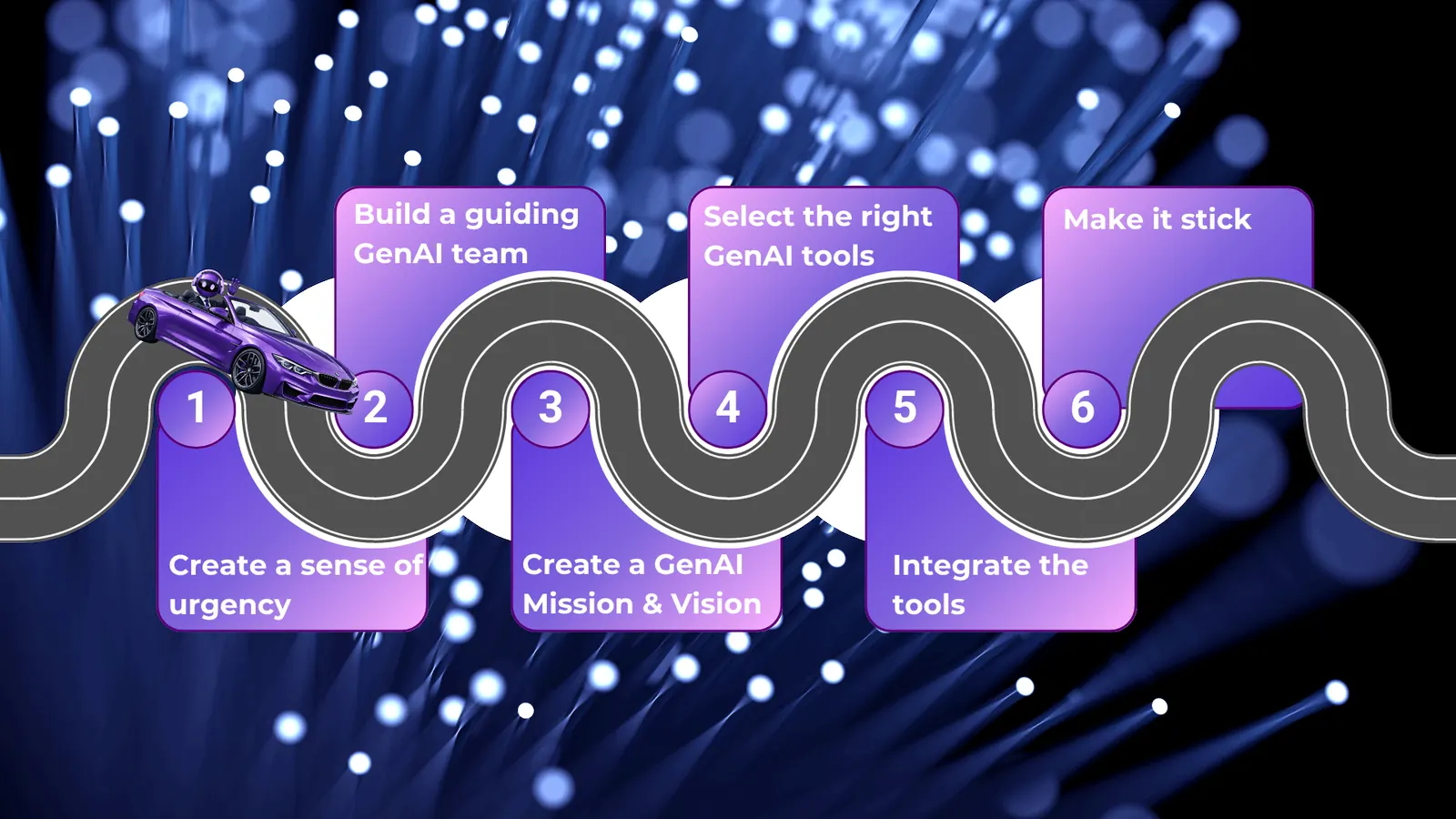
Inspired by the book Our Iceberg Is Melting by John Kotter, AmeCoda has developed six steps to successfully adopt Generative AI in organizations. Whether you want to build workflows, deploy chatbots, or develop agent solutions: these steps are relevant for every organization.
The six steps:
- Create urgency
- Build a strong Generative AI team
- Formulate a Generative AI mission and vision
- Select the right Generative AI tools
- Integrate Generative AI into your organization
- Secure adoption and make it lasting
Below we explain each step.
How to apply this?
1. Create urgency
Change only starts when people feel that standing still is no longer an option. With Generative AI, this feeling is often absent. The technology feels abstract, experimental, or far removed from daily work.
Make urgency concrete by:
- Showing how much time is lost on repetitive work
- Comparing teams that do and don't use Generative AI
- Concretely demonstrating what competitors are already doing
Important: urgency is not about fear, but about reality. Harvard research shows that people accept change better when the goal is clear and doesn't feel threatening [4].
2. Build a strong Generative AI team
Kotter is clear: change fails without a strong team [1]. For Generative AI, this is the same.
At AmeCoda, we work with four roles, inspired by the penguins from the book Our Iceberg Is Melting by John Kotter:
- Fred: Sees what's coming. Knows Generative AI tools, risks, and opportunities. Often from IT or innovation.
- Alice: Sets direction and priority. Ensures Generative AI doesn't become a hobby project.
- Buddy: Builds trust and removes fear. Deloitte shows that trust is the decisive factor in AI adoption [2].
- Jordan: The translator. Makes Generative AI understandable and connects technology to daily work.
This Generative AI team in your organization determines pace, message, and focus.
3. Formulate a Generative AI mission and vision
Many organizations skip this step and start directly with tools. But this is a missed opportunity to increase adoption.
The mission describes why Generative AI is deployed and what you want to achieve in the coming years. The vision describes how work structurally changes through Generative AI in the future.
Example Mission: Generative AI helps employees free up time for work that truly adds value.
Example Vision: Generative AI is a permanent colleague within every process.
And don't forget to communicate this well within your organization. Jordan, the person mentioned earlier in your Generative AI team, would be ideal to continuously share and safeguard this story.
4. Select the right Generative AI tools
Only at this point does technology come into view, and not before. The choice of tools always follows from the organization's mission and vision, never the other way around. There are several important principles that guide these choices:
- Safe and accurate, so solutions remain reliable in daily use
- EU AI Act compliant [6], to work future-proof and responsibly
- One to two primary AI ecosystems, to maintain focus and consistency
A fixed AI ecosystem prevents proliferation of separate tools and accelerates both the learning process and scaling within the organization. In an earlier blog, we go deeper into this: https://amecoda.com/blog/waarom-een-ai-ecosysteem-slimmer-is-voor-groei [5].
Within such an ecosystem, we distinguish five levels of Generative AI solutions that an organization can use. AmeCoda deliberately chooses the Microsoft ecosystem, so the examples will also be Microsoft-related [7].
Five levels of Generative AI solutions
- Workflows and automations: This is the only level that isn't a real Generative AI tool, but it's often underestimated. At the same time, it has great impact and in many cases forms a cost-effective alternative to more complex solutions like agents. A commonly used example is Power Automate.
- Chatbots: Next come chatbots, which offer an accessible start for employees. They can get acquainted with Generative AI in their daily work in a simple way. An example is Microsoft Copilot Chat.
- Chatbot integrations: These chatbots are then integrated into existing systems, becoming part of the work process. Think of Microsoft Copilot Premium within Outlook, Teams, PowerPoint, Word, and Excel.
- Simple agents: Then come simple agents, which are often document- and instruction-driven, such as HR Q&A solutions. Within the Microsoft ecosystem, these can be built as Copilot Agents within the Copilot app.
- Advanced agents: Finally, there are advanced agents. These are process-oriented agent solutions with workflows, tools, and integrations, where agents can even collaborate with each other. Such applications can be developed within Copilot Studio.
It's important not to start directly with advanced agents if your organization is still in an earlier phase. Start with chatbots, for example, and build step by step. By implementing solutions gradually, you increase the chance of successful adoption.
5. Integrate Generative AI tools into your organization
Employees must understand how and why they should use a Generative AI tool. McKinsey emphasizes that employees should not be passive users, but co-owners and responsible for the AI solutions an organization develops [3].
Successful organizations do this through:
- Practical, task-oriented training
- Small, concrete assignments
- Short-term goals
- Visible successes
6. Secure adoption and make it lasting
The biggest mistake? Stopping after the first training. Then Generative AI disappears into the background again. Research shows that continuous training is essential for scalable AI adoption [2].
How do you do this?
- Repeat training structurally
- Work with fixed assignments and use cases
- Include Generative AI in onboarding
- Make clear agreements about usage
Conclusion
The story in this blog, inspired by Our Iceberg Is Melting, shows that Generative AI adoption is not an IT issue, but an organizational change. Generative AI is only truly adopted when urgency, mission and vision, the team, Generative AI tools, integrations, and a fixed structure come together.
The core is simple: start with change instead of with the tool.
References
- [1]https://www.kotterinc.com/bookshelf/our-iceberg-is-melting-2/
- [2]https://www.deloitte.com/us/en/about/press-room/deloitte-generative-ai-survey-finds-adoption-is-moving-fast-but-organizational-change-is-key-to-accelerate-scaling.html
- [3]https://www.mckinsey.com/capabilities/quantumblack/our-insights/reconfiguring-work-change-management-in-the-age-of-gen-ai
- [4]https://camo.hku.hk/overcoming-the-organizational-barriers-to-ai-adoption-harvard-business-review/
- [5]https://amecoda.com/blog/waarom-een-ai-ecosysteem-slimmer-is-voor-groei
- [6]https://artificialintelligenceact.eu/high-level-summary/
- [7]https://www.microsoft.com/en-us/microsoft-365-copilot